Awakening Spring Tea

Awakening Spring Tea

Share This Post

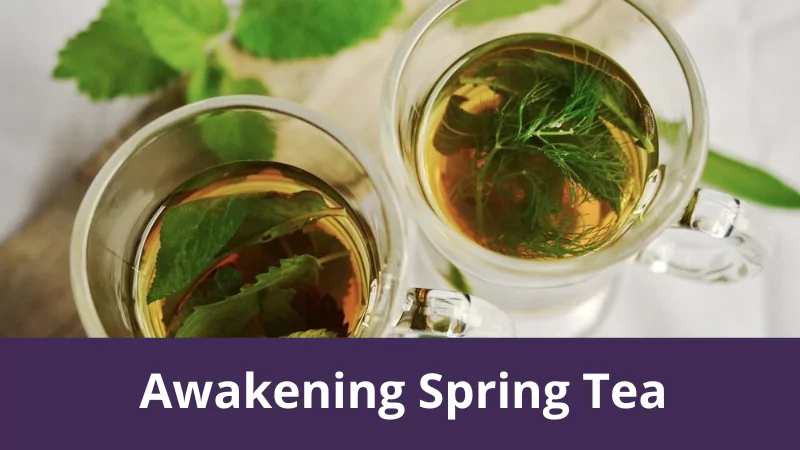
Awakening Spring Tea (yields about 8 cups)

  • 1/2 tablespoon of dried nettle leaves
  • 1/2 tablespoon of dried chickweed leaves
  • 1 teaspoon of dried dandelion leaves
  • 1 teaspoon of dried calendula flowers
  • 1 teaspoon dried red clover flowers
  • 1/2 teaspoon of dried mullein flowers
  • 1/2 teaspoon of dried linden leaves

Additional Herb Options

  • 1 teaspoon of goldenrod flowers (If you are especially prone to severe allergies with the blooming of spring)*
  • 1/2 teaspoon of parsley leaves (If you are looking for more earth-based foliole nourishment)*

If possible, wildcrafted is even better than cultivated

Add 1 teaspoon of dried herbs (or 3 teaspoons of fresh herbs) to 1 cup of boiling water. To infuse the tea, put the herbs in a teapot or cup, using an infuser for easy removal. Pour boiling water over the herbs and allow the tea to steep covered for 5-10 minutes. Make sure to cover the teapot to keep the heat from dissipating. Then strain, serve and enjoy!

~ If you choose to use fresh herbs, use 3 times the amount of dried herbs in your tea blend. If harvesting yourself, make sure to give gratitude back to the earth and plants themselves. Please harvest with gentle love. The general rule of harvesting the aerial parts of plants is that they are best harvested during the peak sunlight hours. This will ensure all the dew has dissipated and the plants have had adequate time to soak up nourishment from the sun. However, if you are ever in doubt about the time to harvest, ask the plant yourself! ~


This recipe is sourced from House of Citrine.

Related Posts

Conditions

Understanding the Impact of Genetic Variants on Detoxification Symptoms

Welcome to our health and wellness blog! Today, we’re delving into an intriguing detoxification aspect–genetic variants’ role. While detox programs are popular for their promise ...
Read More →
Homocysteine: What is it and how is it related to disease?
Genes

Homocysteine: What is it and how is it related to disease?

Homocysteine (Hcy) is a sulphur-containing amino acid, which is derived during methionine metabolism and this is  the only way it is produced in the body. ...
Read More →
How to find out if you have the MTHFR gene mutation
Genes

How to find out if you have the MTHFR gene mutation

How to find out if you have the MTHFR gene mutation? MTHFR is an essential enzyme involved in the metabolism of dietary folate and links ...
Read More →
Unmetabolized Folic Acid Is Detected in Nearly All Serum Samples from US Children, Adolescents, and Adults
MTHFR

Unmetabolized Folic Acid Is Detected in Nearly All Serum Samples from US Children, Adolescents, and Adults

Abstract Background: Serum total folate consists mainly of 5-methyltetrahydrofolate (5-methylTHF). Unmetabolized folic acid (UMFA) may occur in persons consuming folic acid–fortified foods or supplements. Objectives: We describe ...
Read More →
Conditions

Why Genomic Testing is a Game-Changer in Clinical Practice: Improving Patient Outcomes Through Precision Health

In recent years, healthcare has moved towards more personalised approaches, with genomic testing emerging as a powerful tool to tailor treatments to each individual. Unlike ...
Read More →
What Copper Does For Us
MTHFR

What Copper Does For Us

Have you ever seen copper-free multi-vitamins or read about the zinc to copper ratio and wondered if you need more or less copper to support ...
Read More →
Scroll to Top
Carolyn Ledowsky

Stay Connected!

Sign up for our monthly newsletter with current MTHFR research, health tips, recipes, special offers and news about upcoming events including Carolyn’s live Q&A.

Subscribe