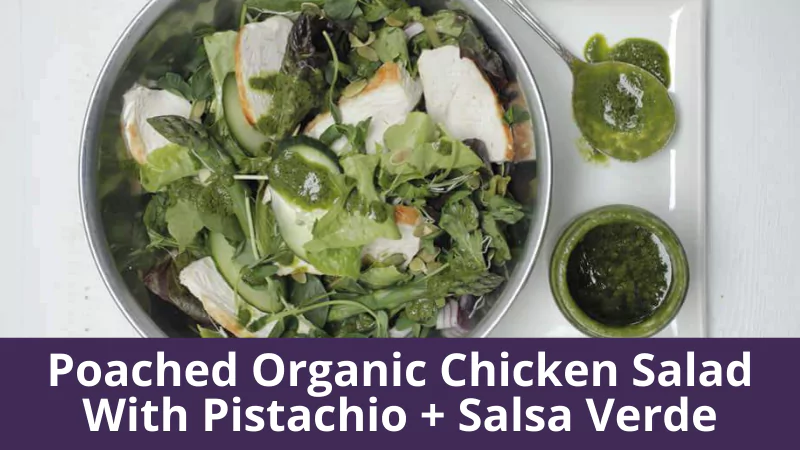
POACHED ORGANIC CHICKEN SALAD WITH PISTACHIO + SALSA VERDE

Poached Organic Chicken Salad With Pistachio + Salsa Verde

Share This Post

By Teresa Cutter

INGREDIENTS

Serves 2

4 good handfuls mixed leafy greens

1 cup alfalfa

½ cup snow pea sprouts

1 Lebanese cucumber, sliced

1 bunch asparagus, trimmed

handful chopped mint and parsley

20 g pumpkin seeds

20 g pistachio chopped

300 g poached or grilled skinless chicken breast, sliced

Salsa Verde

1 bunch parsley leaves

1 bunch mint leaves

1 lemon

½ cup cold pressed olive oil

METHOD

  1. Mix all ingredients for the salad into a large bowl.
  2. Make the dressing by combining the herbs, lemon zest, juice and olive oil into a good high-speed blender.
  3. I love to use my Vitamix for this as it blends up the herbs to a wonderful smooth puree.
  4. Season with a little pepper.
  5. Serve each salad with 2 tablespoons of dressing and enjoy for a healthy lunch or dinner.

NOTES AND INSPIRATION

How to poach a chicken breast:

Place 2 chicken breasts, 3 cups of water, a pinch of salt, juice of 1 lemon and the stems of a bunch of fresh parsley or thyme in a saucepan. Bring to the boil gently, then turn down the heat to very low… Cover and simmer on a gentle heat for 15 minutes (do not boil). Check to see if they are fully cooked through. Remove the chicken breasts and use as required. Enjoy hot or cold.

Other protein sources can be used in place of the chicken such as grilled white fish, tinned tuna or wild salmon, sardines – even rare cooked grass-fed beef.

Vegetarians can use cooked tempeh or organic eggs in place of the chicken for added protein.

Sourced from The Health Chef

Related Posts

Conditions

MTHFR and Methylation: A Critical Insight for Health Practitioners

As a health practitioner, you know that optimal biochemical function is fundamental to patient well-being. One of the most critical yet overlooked biochemical pathways is ...
Read More →
Conditions

Understanding the PEMT Gene: Why It Matters for Your Health

In the world of personalised health, genetic variations can tell us a lot about how our bodies function and the best ways to support them. ...
Read More →
Conditions

What are SNPs, and why are they important in clinical practice?

What are SNPs, and why are they important in clinical practice? SNPs, or single nucleotide polymorphisms, are the most common type of genetic variation. They ...
Read More →
Apps, Sulphur and do you have Pyroluria? Findings from the MABIM Conference
MTHFR

Apps, Sulphur and do you have Pyroluria? Findings from the MABIM Conference

By Carolyn Ledowsky The Chemical Heritage Foundation recently played host to the MABIM Conference. I travelled to Philadelphia, USA to attend the two day conference ...
Read More →
Role of Vitamin B12 in Pregnancy Related Obesity
MTHFR

Role of Vitamin B12 in Pregnancy Related Obesity

You are B12 deficient when your serum B12 is <150 pmol/l according to our Australian Labs. But the reality is that this number is way ...
Read More →
MTHFR

Low Homocysteine Levels: What are The Consequences?

What Is Homocysteine? Homocysteine is an amino acid derivative that serves as an intermediate in the synthesis of methionine and cysteine. Low homocysteine develops when ...
Read More →
Scroll to Top
Carolyn Ledowsky

Stay Connected!

Sign up for our monthly newsletter with current MTHFR research, health tips, recipes, special offers and news about upcoming events including Carolyn’s live Q&A.

Subscribe